Thursday, 14 November 2013

The Italian Design


A couple of weeks back I decided to write a post on the influences impacting typewriter design. This post has been finished for a while, just unpublished. It was inspired in part by a conversation I had with Scott K on the way back from a visit to John’s place in September. We were discussing the depth of knowledge that the typosphere (with a notable mention of Robert Messenger) delivers in relation to the corporations, patents and people behind different typewriter designs. Scott pointed out however, that less often discussed in the typosphere is the influence of the social and cultural contexts of the era on a typewriter’s aesthetic design. I thought this was a good point. Because designs are not dreamed up by designers in isolation, but are products of the prevailing social, economic, even political conditions and sentiments of the time. Thus the influences acting upon the designer of a given typewriter make for a very interesting discussion; a discussion that with the help of the typosphere and my university’s library, one that I’ve decided to have a crack at. I share with Ton and many others a great love of Olivetti and I thought what better place to start than the first typewriter I ever owned, the Olivetti Lexikon 80. 

Impatient Snow Collection

Ton S Collection (Ton S. 2012a)

There is already a wealth of information on the enigma that is the Olivetti corporation (Marin 2009, Messenger 2011a, Messenger 2011b, Ton S. 2012b, Ton S. 2013- full references at the end of the post). There is also plenty of information available on the Lexikon 80 and later varients (Ton S 2012a, New York MOMA etc etc) including of course Rob Bowker's info on his own awesome green Graphika. We know already that the Lexikon 80 (released 1948) is an iconic design by an iconic designer, one which has found its way into millions of offices, homes, the New York Gallary of Modern Art, countless blog posts and Industrial Design textbooks. It was designed by Marcello Nizzoli (1887-1969) in collaboration with engineer Guiseppe Beccio. Nizzoli was a painter, designer and graphic designer who began work for Olivetti in 1930, rising through the ranks to become head product design consultant by 1936 (www.marcello–nizzoli.com). 

However, while Nizzoli was the designer of the Lexikon and this machine is correctly attributed to Nizzoli’s incredible imagination, it should also be seen as very much a product of the time and a precursor for much to come. 

New York Gallery of Modern Art Collection: Source: http://www.moma.org/collection/artist.php?artist_id=4316
 
 
Impatient Snow Collection

The year the Lexikon 80 was released (1948) was an important year for Italian Industrial Design. Woodend (1997) quotes Andresa Branzi as saying that Italian design of the 50’s should really be seen to begin in 1948. The general elections in Italy in 1948 installed a centrist government with an eagerness to develop markets and stimulate the economy. This government correctly identified promoting Italian design and production as a means of doing this. The export of fashion, appliances, motor-vehicles and (I assume) typewriters to the rest of the world, played a part in Italy’s exports shooting up by a whopping 259% between 1951 and 1962 (Woodend 1997). For comparison England and France posted increases of 29% and 86% respectively during the same period (Woodend 1997). What this means, I assume, is that the Italian industrial design and manufacturing industries at the time the Lexikon’s and Lettera 22’s were selling, had the confidence of the government; a government who was keen to promote and export designs and to open up new markets. Designs shifted towards elegance and top-notch workmanship, targeting the quickly burgeoning high-end markets. This provided for a “move away from democratic idealism toward a more style-conscious aesthetic geared towards the pockets of the more affluent sectors of society” (Woodend 1997, pp.123).

The products of Industrial Design in post-war Italy were, in my opinion, downright gorgeous. Italy was a distinct trend-setter in design during this time and Italian designs of the late 1940’s played a large part in shaping and determining what we now associate with 50’s fashion. While the Lexikon 80 is original in its own right, close parallels can be drawn between Nizzoli’s 1948 Lexikon 80 with Italian automotive designs of the time, including the curves of the original Vespa motor-scooter of 1946 and the Cisitalia 202 sports car of 1947. Following this style as well is the stunning Gio Ponti designed La Pavoni coffee machine of 1949. 

 Source:
http://www.scootermaniac.org/modele,Piaggio,Vespa-98,38.html
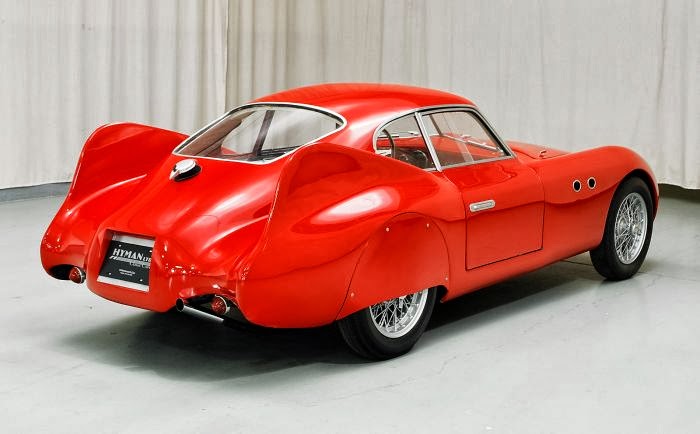
 Source:
http://images.hemmings.com/wp-content/uploads//2013/03/1947Cisitalia202MM_02_700.jpg

 Source:
http://www.alfa-male.com/italian-design/architecture/ 

The aesthetic of this design has been described as an “organic sculptural form”. Now I freely admit I’m not quite arty enough to know what this really means, but whatever it is, it is clearly a form which Nizzoli followed in his other designs for Olivetti in the late 40’s and early 50’s including the Divisumma 14 (1947),  Summa 15 (1949) and of course the beautiful Lettera 22 (1950). 

New York Gallery of Modern Art Collection: Source:

IDE Virtual Design Museum Collection. Source:
 
Summa 15: Source:

Impatient Snow Collection

Where Italy went, the world followed. One of my favourite car designs, the iconic Australian built FJ Holden, was released five years after the Lexilon 80, in 1953, but it still looks like the automotive equivalent of hopping right inside your own Lexikon 80 and driving off.....

Source:


References

Marin, Fransu (2009) Hispano Olivetti- a brief history. ETCetera #86, June 2009.

http://www.marcello-nizzoli.com/

Messenger, Robert (2011a)- http://oztypewriter.blogspot.com.au/2011/05/100-years-of-olivetti-typewriters-la.html

Messenger, Robert (2011b) http://oztypewriter.blogspot.com.au/2011/05/100-years-of-olivetti-

Ton. S (2012b)- http://idreamlo-tech.blogspot.com.au/2012/10/pieces-of-olivetti-vision.html

Ton S (2012a) http://idreamlo-tech.blogspot.com.au/2012/07/holy-grail-reveal-olivetti-lexikon-80.html

Ton S. (2013)- http://idreamlo-tech.blogspot.com.au/2013/07/the-olivetti-bible-and-new-convert.html

Woodham, J.M. (1997). Twentieth-Century Design. Oxford University Press, Oxford UK


Sunday, 27 October 2013

Repairs and new additions

My girlfriend went to Melbourne last weekend with a friend of hers, leaving me with a positively delightful amount of time to dedicate to pottering around in the laundry with typewriters, while neglecting more important matters. I detail some of the events and very minor repairs carried out over the weekend below.


Underwood Noiseless 77
My gorgeous shiny and expensive Underwood Noiseless 77 which I've spoken about in a previous post here had been in need of new feed-rollers for months. Not having found anything suitable in the meantime and after a good boiling didn't do the trick with the existing rollers, I decided to try simply shaving the edges of the squared rollers off with a pocket knife, leaving them slightly rounder.


Believe it or not this actually did the job. I was expecting to need to roll a bit of duct-tape around one or two to fatten them up to size, but no. I now have a fully functional sparkly new looking Underwood Noiseless. If I happen to find suitable replacement rear feed-rollers at a later date I can always fit them in. Accessing and removing the rear feed-rollers on these machines (Remington Noiseless 7 / Underwood Noiseless 77) is a relatively simple matter of adjusting the margin stops to their outer-most limit, activating the paper release to move the rollers away from the platen and lifting the whole assembly (4 rollers attached to a single rod) out of their holder. Moving the carriage to one extremity helps ease of access.

Remington Portable 5
Another satisfying repair was finishing off my shiny Remington Portable 5, for which I had previously borrowed John's tool to straighten the keytops on (mentioned here). After the keytops and the feed rollers had been done, the only thing left was the carriage return lever. I had assumed I would be able to use the carriage return lever off the parts-machine Remington 4 that John had loaned me, however this was not to be the case.

Remington Portable 4 parts machine

 Remington Portable 4 carriage return lever

 Remington Portable 5 carriage return lever (terrible photo, but you can see it's got an almost 90 degree curve in it, as opposed to the Rem Portable 4 one which is almost straight). While the line-spacing mechanism is almost identical on the Portable 4 and 5 models, the difference is the Portable 4 doesn't have platen knobs on both sides, thus the carriage lever doesn't need to bend around anything and thus is designed to sit straight up. So I borrowed this Portable 5 curved carriage return lever off (yet) another Remington Portable 5 that I had bought off eBay a while back.

Fits!

A very minor issue remains when typing, with the bottom of the letters being fainter than the tops, but it's still very legible and I'll get around to that addressing that another day.

Remington Standard 10
A week or two before, I had found what looked to be a Remington Standard 10 on Gumtree going for a half-reasonable amount. A drive over to a leafy outer-south eastern suburb secured me this old beast and it was only on this typewriter-filled weekend that got around to even inspecting it. The seller informed me his father had collected a few old typewriters from businesses around Western Queensland years before. Coming from hot, dry Western Queensland accounts for the layer of dust around most parts and the relative lack of rust considering it's age. All in all it's in passable nick and although the mainspring is slipping when tensioned, I'm sure I'll be able to fix this. The carriage is a little crunchy and it does like to remind you that it's older than the hills, but I wouldn't be surprised that in time I might have myself a working machine. The Standard 10's are rather skeletal looking things, little covering and prone to dust. On the flip-side however, the lack of side-plating (if that's the word) provides you with near-effortless access to much of its innards. My aim for this one is to get it fully functional in time for it's 100th birthday. It's serial number (351496) dates it to early 1914 and so I have around 3 or 4 or so months to get it dressed up and ready to party. Me being famously impatient, I forgot to take a "before" shot when it was covered in dust which I'm rather annoyed about, as it looks much better than it used to. All I've done is give it a once over with a damp, then dry cloth and there's plenty more to do yet......


An unexpected visit
Finally, to top off a rather typewriters kind of weekend, Scott K of The Filthy Platen, rocked up and dumped 12 typewriters on my lawn. These were acquired with a little bit of once-in-a-blue-moon eBay magic that only a deceased estate and truly awful presentation skills can create. Scott tells the full story on his blog here, but to cut a long story short, I scored two of these dusty beauties, one of which was gleaming and typing away like new the very same afternoon. More on this another day.


Monday, 14 October 2013

The naughty Latvian second hand typewriter salesman

I have quite seriously considered writing a children's book named after the title of this post. All I need is to find someone proficient in watercolours to draw me pictures of a hunched, hooded, toothless second hand typewriter salesman rubbing his hands together and chuckling quietly to himself in a dank, dark corner of some picturesque Eastern European castle, while he schemes up his next dishonest transaction... I'll get around to that one day.

The great thing is, however, that the main character in this story is not entirely fiction. Last year before I started this blog and fairly early on in my interest in typewriters, I went to Europe for six weeks. A conference near Copenhagen at the beginning, a conference in Birmingham at the end and the best part of 4 weeks to gallivant about the place as I saw fit. I have a great fondness for England. In Australia, you get a whole bunch of big old loose lettuces in the supermarket. No idea where they're from, you just grab your lettuce and head home, don't think anything more of it. In England you get these dear little lettuces packaged in pairs and they're not just any old lettuces either, they're East Anglian lettuces. I don't know whether the majority of England's lettuce supply happens to come from East Anglia, or if you were in Cumbria say, you'd get Cumbrian lettuces and so forth, but I was in East Anglia and I bought these East Anglian lettuces and these sorts of things warm my heart.


Anyway, I'd been scouring UK ebay for a long time prior, looking for something old, something sparkly and something that would be a great deal cheaper in England than it would be in Australia. Patience paid off and a gorgeous old Corona 3 "pick up only" came up at a very reasonable price within only 15-20 minutes drive of my uncle's house in Sudbury. I contacted the seller saying that if I won it I would collect it around the bank holiday weekend once I was on that side of the world. The price didn't change and with baited breath I stayed up late one night to put in a bid at the last minute. But to my horror, ebay didn't let me bid on account of the seller not offering international postage. At this early stage of my collecting, I simply didn't know ebay worked that way. So I sent an optimistic message to the seller saying how much I'd have liked it and woe is me, etc, and if the sale happened to fall through to let me know.

Enter the naughty Latvian second hand typewriter salesman......

To my surprise, a reply did come from the seller:

"Such a shame - a time waster in Latvia has won it and emailed me to say he 'will take a courier service' and obviously doesn't understand what collection only means! Will have to wait a week or two for the whole thing to sort out no doubt (frustrating), but will save your email and contact you as soon as it falls through, and it's yours with pleasure!"

What ensued however was a rather harrowing affair for the seller, Gill, a wonderful soul, who kept me updated throughout the saga. It turned out the naughty Latvian second hand typewriter salesman had set up a fraudulent UK ebay account, using a non-existent postal address in central London and a fake phone number, just in order to be able to bid on "no international postage" items. He had won the auction and then demanded the typewriter be couriered to Latvia despite the listing being a "pick up only". Gill had emailed him saying that it's pick up only and she wouldn't courier and that she would cancel the transaction, but then he refused to accept the cancel and started sending threatening emails and the whole thing sounded rather nasty. I remember sending the money via paypal when she thought it had been sorted, but then she refunded it again, citing further complications and ended up getting out of the sale via an unpaid item dispute as he had not paid within the allocated timeframe. Gill advised me that it appeared the naughty Latvian second hand typewriter salesman was an antique dealer based in Latvia, dealing mainly in typewriters and that he would buy cheaply from around Europe and on-sell at a significant mark-up. In the end, my dream did come true and couple of weeks later my uncle and I went for a drive in the countryside and came back with a gorgeous old 1921 Corona 3.


Gill was a delightful person, about to be married only a week after I picked up the Corona. She runs a small business selling items for local people via ebay and taking a small percentage of the sale. The naughty Latvian second hand typewriter salesman had also won a bid on an ancient upstrike Remington of some description. Gill was selling and she offered it to me for £15 when I came to pick up the Corona and my goodness if only my suitcase was larger!!

Separately I had also bought a late 20's Corona 4 from Cheshire and organised to have it sent down to my uncle's house in Sudbury. It is delightfully cheap to send typewriters locally around England, but awfully expensive to send them overseas to Australia. So an enjoyable couple of days was spent recuperating from my previous travels in my uncle's house, tinkering away with my new Corona 3 and Corona 4. I have little back-story for either typewriter, except that the Corona 3 was previously owned by an elderly gent named Nick who had bought it himself from an antique or second hand store over 40 years ago. Its condition indicates pretty limited use during that time. Both the Corona 3 and 4 type well and required no mechanical work at all.


My suitcase was enormous and flimsy and had been bought for $4 at a garage sale while typewriter hunting before I left Australia. I left my suitcase at my uncle's while I spent a week visiting and traveling around London, Bath and Brighton and it was only when I was loading the suitcase into Malcolm's car, after I'd put in the two typewriters, some other stuff I'd bought in England and half a kilo of Marmite, that I thought "I've got to get this thing back to Australia". The suitcase as I later found out was 29.6kg and the wheels began to bust as I ambled from the mainline trains to the tube at Liverpool Street station. By the time I was hobbling up and down stairs between the Euston Road tube and the Euston mainline station to catch the train to Birmingham they were completely knackered. Annoyed commuters on the crowded tube got the toothy grin that only a man in possession of two freshly purchased antique typewriters can give. I do hope the sight of a short weedy Australian struggling with an enormous bulging suitcase with busted wheels, sweating profusely in a t-shirt on a cloudy 16 degree day as he hobbled towards the Birmingham train, might have provided at least a little mirth to the crowds at Euston that day. Once in Birmingham it was a simple matter of a taxi from the station to the hotel and another taxi to the international airport four days later after the conference, but I think it'll take me a long time to forget that rather memorable trip from Sudbury to Birmingham that day.

Sunday, 29 September 2013

Repairing Ken Beckett's Remington Portable 5


A while ago I bought a Remington Portable 5 that used to belong to a Methodist minister by the name of Ken Beckett- a Patrol Padre in the late 40's - early 50's, with a patrol area three times the size of the state of Victoria. I posted on this typewriter and its incredible journeys a couple of months ago here. As mentioned, the repairs necessary were the feed rollers and the mainspring. The mainspring was almost OK, but not quite. It would tighten to a point before slipping and unravelling inside its casing. When tightened to just before this point, it would type OK for most of the page, but get very sluggish towards the right margin.


After being overseas for a couple of weeks and very busy at work either side of the trip, nothing had been done on any of my machines for ages and an email from Scott from the Filthy Platen asking whether I wanted to join him on a trip down to John’s place on Sunday was exactly the motivation I needed: “Yes please”. So Scott, Jane and I drove down last Sunday. Among many other purposes, this trip enabled me to finally pass onto Scott the parts-machine Smith Premier 10 which I spoke about here and for John to give me a seized parts-machine Remington Portable 4. From this machine I shall (hopefully) be able to extract the line spacing mechanism, clean it up and attach it to my own older model Portable 5 on which the line spacing mechanism is missing (mentioned here). The lucky thing however, is that the Remington Portable 4 and Portable 5 models have an identical mainspring, so I was also able to transfer the parts-machine Portable 4’s mainspring to Ken Beckett's Remington Portable 5.

The repair
The mainspring isn’t a difficult repair if you know how. I didn’t know how, but a combination of much appreciated help from both John and Scott means I can now blog about it as if I knew how to do it all along. Firstly detach the drawband, or in my case, cut off the improvised fishing wire draw-band and unwind it off the mainspring. You need a special screw-driver to undo the locking nut on the mainspring (see below).

Scott came to the rescue here and in a flurry of sparks, worked some angle-grinding magic on a broken screwdriver such that a divot was made in the middle of the blade. Once the locking nut is off, simply pull off the mainspring and fit the replacement one. Without a replacement mainspring it’s still possible to pop the top off the mainspring mechanism and re-attach whichever end has come out of its divot making it slip, but I’m glad I didn’t have to resort to this. Tinkering with exposed mainsprings is a bit like playing with fire. I learnt this the hard way from experience with the pull-start mechanism from my old lawnmower.

 Disconnect the rod above, undo mainspring locking screw

Simply take off and replace. The circular-saw-shaped ratchet thing also needs to come out and be attached to the new mainspring. It fits into the top of it, pretty straight forward.

When securing the replacement drawband onto the mainspring (in my case fishing wire), thread it through the hole in the top of the mainspring (visible in the photos) and tie a knot. Be careful however that the knot is descrete enough that it won't catch on anything as the spring winds and unwinds. One feels like quite the goose when one finds out that the mysterious knocking coming from the carriage at a certain point across its run is actually just the fishing wire tied to the mainspring bumping against the frame as the spring turns.

The feed rollers were the next job and there's no need to go into detail for this repair. What I will say however, was that even after replacing the feed-rollers with those from the Remington 4 Portable parts machine (which were somehow still in great nick, must have been replaced in its life time), it still wasn't rolling in paper straight. After carefully inspecting the rollers and checking the rod on which they roll was completely straight, I found that the metal frame in which the whole assembly sits wasn't completely straight. Without much room to move with the long nosed pliers to straighten it and without the time or patience to take the whole assembly off, I solved the problem with a slight bend of the metal with the pliers and also rolling on some duct-tape to fatten one of the end rollers. With a bit of trial and error it's now rolling in paper satisfyingly straight.


The first few verses of Duke Ellington's famous song came out OK, it's not a bad typer at all. But I can see that some further work (potentially just lubrication) is necessary for the carriage shift, as it's not dropping back quite fast enough if I'm typing at any speed. The ribbon also hasn't been replaced and is rather faint. Nevertheless, the old girl is back working again and I'm very pleased to have it back doing what it does best. I haven't heard back from Ken Beckett's grandson, but I'm sure he'd be pleased to know it's working again. Cosmetically I'm in no hurry at all to do anything to it at all other than a wipe with a damp cloth. It certainly doesn't look particularly spick and span, but then something that has travelled tens of thousands of kilometers shouldn't!


Friday, 13 September 2013

Trackpoint / pointing stick / joy nub


Yesterday I was in South Africa. But I'm not any more. During a week and a half there, I didn't see a single typewriter. Not even one. Although I must admit to not having looked terribly hard. So while nothing new was learned about typewriters in this foray across the Indian Ocean, something was learned about the design of more modern writing technologies. What brought me to South Africa in the first place- Cape Town to be more exact, was the Interact 2013 conference. This conference deals with the many and varied facets of Human Computer Interaction and technology design and my research institution kindly paid for the air tickets over there on account of the paper I was presenting.
Human-Computer Interaction or HCI represents an incredibly diverse and very exciting field of research that I have only become acquainted with during the past couple of years. The C in HCI is not restricted to personal computers and encompasses- mobile phones, digital noticeboards, basically pretty much any sort of computerised interface that we interact with in everyday life. A theory common to a lot of HCI work is that the people who will ultimately use a device or interface ought to be included in the design process. In relation to typewriters, I'd love to know whether and how typewriter manufacturers integrated their target market into usability testing and design. Also, of interest to many of us typewriter tinkerers, one of the keynote speakers at the conference mentioned the trend of using 3D printers for creating parts for vintage technology is becoming more wide spread and something that will certainly revolutionise the preservation of historical technology in the years to come. 

Once the conference was finished I had five days to explore. Last Saturday a group of 9 random conference participants with a couple of extra days up our sleeves hired a taxi-van and spent a day exploring the national park around Cape Point and meandering back through some of the seaside towns. This group was comprised of a couple of student volunteers like myself, some career academics and practising designers. Although ages, experience and research fields differed, we had commonality of having participated in some way at the conference. Which brings me to the title of this post and frankly, the closest this post is going to come to discussing typewriters at all. Which is to say not very close.
So what is the trackpoint / pointing stick / joy nub? It is of course the little red knob in the middle of keyboards on certain modern day typewriters (laptops) that moves the cursor. Although Wikipaedia uses "Pointing stick", I knew of it as a trackpoint, but have also heard of it referred to as a joy nub (as to joy stick).


Regardless of what this thing is called, it is something that you use, but you don't really think about. It's just there and it works. Which is the hall-mark of a good interface design really. Because if you are aware you're using an interface to access something (rather than concentrating on what it is you're actually accessing), it's probably because it's difficult to use. Thus I would never have thought any more about this little thing, had it not been that the man responsible for designing it happened to be one of the random assortment of people sharing the taxi around Cape Point that day. The man responsible is Ted Selker, pictured below photographing the amazing scenery from the back of a truck. Ted is a computer scientist and designer with a very impressive list of achievements to his name.


But what was nice about that particular day, was the fact the that work wasn't the main focus of the conversations between everyone. Rather than representing our work and our respective institutions like we did at the conference, we were instead a bunch of 9 people from 6 countries, enjoying a grand day out on the Western Cape. 


Now being freshly back in Australia I've got to come to terms with a whole bunch of work waiting for me, unseasonably hot weather and new conservative idiot of a Prime Minister running the country, who won the election while I was away. But then again, home is where the heart is and where the majority of my 15 typewriters are, so it's not all bad news.

Source of trackpoint picture: http://www.codinghorror.com/blog/2006/05/touchpad-vs-trackpoint.html